
“Night-shift exemption after parental leave: not possible”, “told it can’t be done because we’re short-staffed”. Is that the kind of phrase you searched for?
This article sorts out when a night-shift exemption can and cannot be refused, based on the text of Article 19 of the Child Care and Family Care Leave Act (育児・介護休業法), Article 66 of the Labor Standards Act (労働基準法), and the views published by the Ministry of Health, Labour and Welfare (MHLW).
In many cases, a refusal of a night-shift exemption has little legal basis.
However, which article applies changes depending on whether you are pregnant or within one year of giving birth, or past that first year, so the first thing you need is to check which category you fall into.
If you accept “if it can’t be done, that’s that” without knowing this difference, you give up an exemption you could in fact request again.
You may end up rushing into resignation or a job change.
The article covers how far “we’re short-staffed” holds up as a reason for refusal under the law, how to resubmit the request, where to consult if refusals continue, and the options of changing how you work or changing jobs.
By the end, you should be able to explain in your own words which system applies to your case and what to do next.
Diagnose your own case
Depending on how much time has passed since the birth, the applicable law is one of the following two.
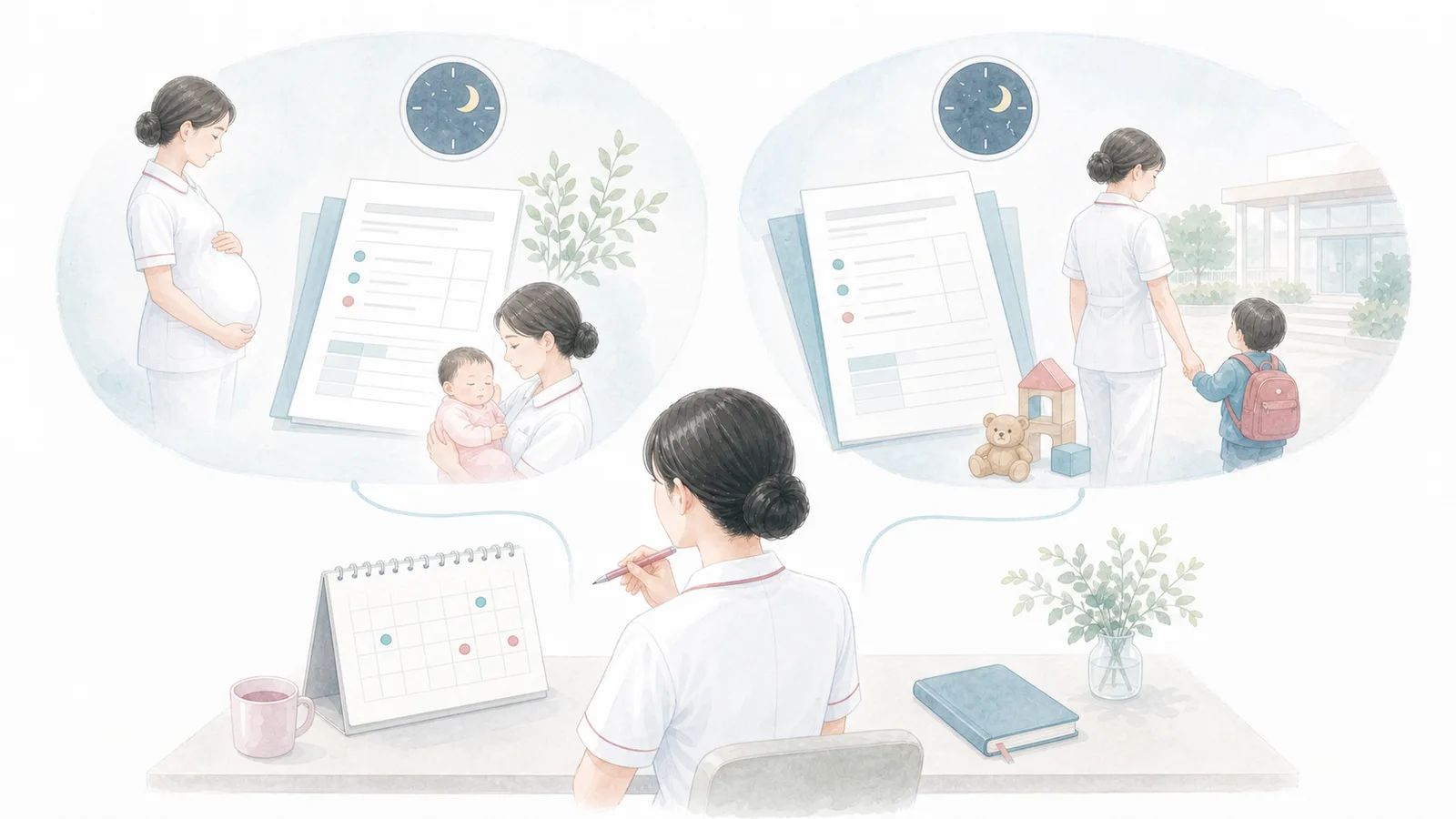
When you are told “we can’t exempt you from night shifts”, the first thing to check is how long it has been since you gave birth.
There is in fact more than one law behind night-shift exemptions. There are two provisions: Article 66, paragraph 3 of the Labor Standards Act, and Article 19 of the Child Care and Family Care Leave Act.
Which one applies changes greatly how far the employer can say “no”.
Just as maternity leave switches over to child care leave, think of it as the applicable system changing with the period.
Are you now within one year of giving birth? Or already past one year?
Check which of the following two you fall under.
- Within one year of the birth → covered by Article 66, paragraph 3 of the Labor Standards Act
- Past one year, and before the child starts primary school → covered by Article 19 of the Child Care and Family Care Leave Act
If you are pregnant or within one year of the birth
Pregnant women and women within one year counted from the date of birth are covered by Article 66, paragraph 3 of the Labor Standards Act.
Article 66, paragraph 3 protects “expectant and nursing mothers” (妊産婦), that is, women who are pregnant or have not yet passed one year since giving birth.
It provides that if such a worker requests it, the employer must not have her work late-night hours (from 10 p.m. to 5 a.m.).
What matters here is that the exception in Article 19 of the Child Care and Family Care Leave Act, which allows refusal “where it would impede the normal operation of the business”, does not exist in Article 66.
A request within one year of the birth is harder to refuse than under Article 19 and is likely to receive stronger protection.
If this is your case, check in the next heading how far Article 66 binds the employer.
If you are past one year since the birth
If more than one year has passed since the birth, and the child has not yet started primary school, you are covered by Article 19 of the Child Care and Family Care Leave Act.
Article 19 provides that if a worker raising a pre-school child requests it, the employer must restrict late-night work.
But unlike Article 66, it contains an exception allowing the request to be refused “where it would impede the normal operation of the business”.
Perhaps you feel that “our workplace is short-staffed, so we probably fall under this exception”?
The single word “short-staffed” is not enough. A staffing shortage alone does not automatically bring the exception into play.
What does count as this exception is examined next, in “The legal basis for night-shift exemption”, where we set the two provisions side by side.
The legal basis for night-shift exemption
There is in fact more than one law behind the “night-shift exemption”.
The word used in the statutes is not “night shift” but “late-night work” (深夜業), but you can treat the meaning as nearly the same.
From pregnancy to one year after the birth, the applicable provision is Article 66, paragraph 3 of the Labor Standards Act. From one year after the birth until the child starts primary school, it is Article 19 of the Child Care and Family Care Leave Act.
Both impose the same duty on the employer, “if requested, do not assign late-night work”, but there is a large difference in whether the employer can refuse.
Article 66 of the Labor Standards Act: pregnancy to one year after birth
Article 66, paragraph 3 of the Labor Standards Act provides that if an expectant or nursing mother requests it, the employer must not have her work late-night hours (source: e-Gov Laws and Regulations, “Labor Standards Act”).
An expectant or nursing mother means a woman who is pregnant or has not yet passed one year since giving birth.
Article 66, paragraph 3 contains no exception anywhere that allows the employer to refuse, so for a request within one year of the birth, the text gives the employer no room to refuse.
It makes no difference if you have only just joined.
It is one of the few rights that can be exercised regardless of length of service.
Article 19 of the Child Care Leave Act: one year after birth to school age
Article 19 of the Child Care and Family Care Leave Act provides that if a worker raising a child who has not yet started primary school requests it, the employer must not have them work late-night hours (source: e-Gov Laws and Regulations, “Child Care and Family Care Leave Act”).
So far it looks like the same mechanism as Article 66.
But Article 19 adds an exception to the effect that the employer may refuse where it would impede the normal operation of the business.
In what cases can operation be said to be “impeded”?
The concrete test is examined later, in the chapter “Is being short-staffed a valid reason to refuse?”.
Article 19 also contains conditions that exclude, for example, workers with less than one year of service and workers who have a co-resident family member able to care for the child at night.
The details of those conditions are in the next chapter.
The difference between Article 66 and Article 19 might be pictured as the difference between a counter where “you can always take leave if you ask” and one where “you can usually take leave, but may be turned away when it is busy”.
| Labor Standards Act Art. 66(3) | Child Care Leave Act Art. 19 | |
|---|---|---|
| Period covered | Pregnancy to one year after birth | One year after birth until the child starts school |
| Length-of-service condition | None | One year or more (with exceptions) |
| Exception allowing employer refusal | None | Where it would impede the normal operation of the business |
Next, we check the conditions under which you fall outside the exemption under these two systems.
Conditions that exclude you from the exemption
You are excluded from the night-shift exemption if any of the following four conditions applies.
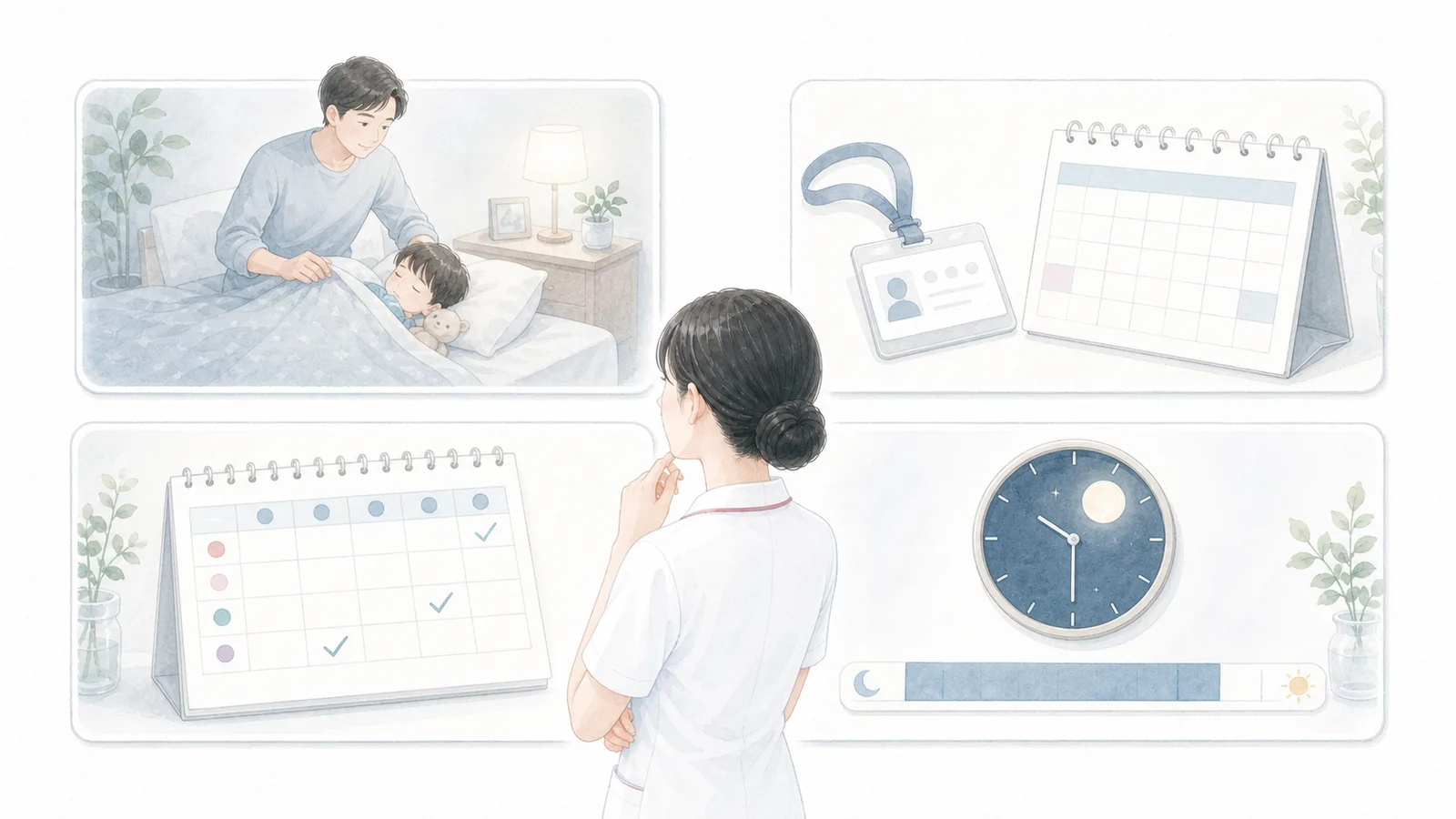
When you are told “you are not eligible”, what should you check first? Whether the reason you were given actually matches a condition set by law.
The restriction on late-night work (work between 10 p.m. and 5 a.m., the so-called night shift) under Article 19 of the Child Care and Family Care Leave Act has exclusion conditions.
There are four.
If none of them applies to you, you can in principle request the exemption.
You have a co-resident family member who can care for the child at night
This is where a family member living with the child is normally able to care for that child during late-night hours.
But this “family member able to care” has detailed conditions of its own.
- Aged 16 or over.
- Not working late-night hours, or working late-night hours on no more than three days a month.
- Not in a state where caring is difficult because of injury, illness or disability.
- Not within the period from six weeks before the expected date of delivery (fourteen weeks for a multiple pregnancy) until eight weeks after the birth.
Only when a family member meeting all four of these lives with you does the exclusion apply.
You have been employed for less than one year
Less than one year of service alone does not, in fact, exclude you.
You can be excluded only where a labour-management agreement, concluded between the company and a majority of workers, provides that workers with less than one year of service are excluded.
Check with your employer whether such an agreement exists.
Your scheduled working days are two or fewer a week
This applies to people whose original schedule is two days a week or fewer, not to those working full-time or on shifts of three or more days a week.
All of your scheduled working hours fall in the late-night period
This is where your working hours from start to finish fall entirely between 10 p.m. and 5 a.m., and normally does not apply to shift workers who do both day and night shifts.
To put it another way, checking whether a co-resident family member can care for the child at night is like checking in detail whether there really is someone who can stand in for you.
Merely living together does not make someone a substitute. Only once age, work situation and health are considered is the condition met.
Shift workers in healthcare and care will in most cases not fall under “two days a week or fewer” or “all hours late-night”.
That leaves two conditions to check: whether there is a co-resident family member able to care for the child at night, and whether there is a labour-management agreement excluding workers with under one year of service.
If neither applies and you are still being told you are not eligible, the explanation may lack a basis.
So, is the commonly cited “short-staffed” a valid reason to refuse?
Is being short-staffed a valid reason to refuse?
The three reasons most often given for refusing a night-shift exemption are, none of them, a valid basis on their own.

By now you can probably see which law you are covered by.
The next question is whether the reason for refusal you were actually given is legitimate.
In short, “we’re short-staffed”, “we have an in-house nursery” and “we’d like you to go part-time” are, each on its own, highly likely to be no valid basis for refusing a night-shift exemption.
Let us check them one by one.
Refusal on grounds of staffing shortage
Article 19 of the Child Care and Family Care Leave Act sets, as the case in which the employer may refuse, “where it would impede the normal operation of the business”.
This condition is not met merely by a state of being short of staff.
Following the reasoning in the MHLW Q&A on reviewing working hours for energy saving, 5: consideration for workers with family responsibilities, it is limited to cases where, even after the usual efforts such as securing replacement staff and rearranging the roster, operation still cannot continue.
Effort is the premise.
By analogy, the mere forecast that “if we raise prices, customers might leave” is not a reason to avoid raising prices.
Likewise, unless it is the result of exhausting consideration and adjustments, a night-shift exemption refusal is hard to accept as justified.
Did your workplace consider rearranging the roster or arranging cover before telling you the exemption was not possible?
If you were simply told “we’re short-staffed, so no” without any consideration, that one-line explanation most likely falls short of what the law requires.
What is needed is not the word “short-staffed” but evidence of concrete consideration.
Refusal because there is an in-house nursery
Some people are told “we have an in-house nursery, so if you use it you can do night shifts”, but whether an in-house nursery is available is not among the requirements for requesting a night-shift exemption.
The cases Article 19 excludes are only the limited ones set out in the enforcement regulations, such as having a co-resident family member normally able to care for the child at night.
Whether the company provides a childcare facility is a separate matter from these exclusion requirements.
Whether to use the in-house nursery is only one option the worker can choose. It is not a reason to give up the exemption.
Being pressed to switch to part-time
Some are told “if you want a night-shift exemption, switch to part-time”, but the night-shift exemption is a right granted to workers who meet the requirements, regardless of employment type.
You can request it while remaining a full-time employee.
A change of employment type cannot be raised as a condition of the exemption. If you are being pressed to resign or change employment type, that is a proposal from the company unrelated to the right of request the law provides.
Once you know the refusal has no basis, the next step is the procedure for resubmitting the request.
How to resubmit a night-shift exemption request
When resubmitting, put the following points in writing and hand them in.
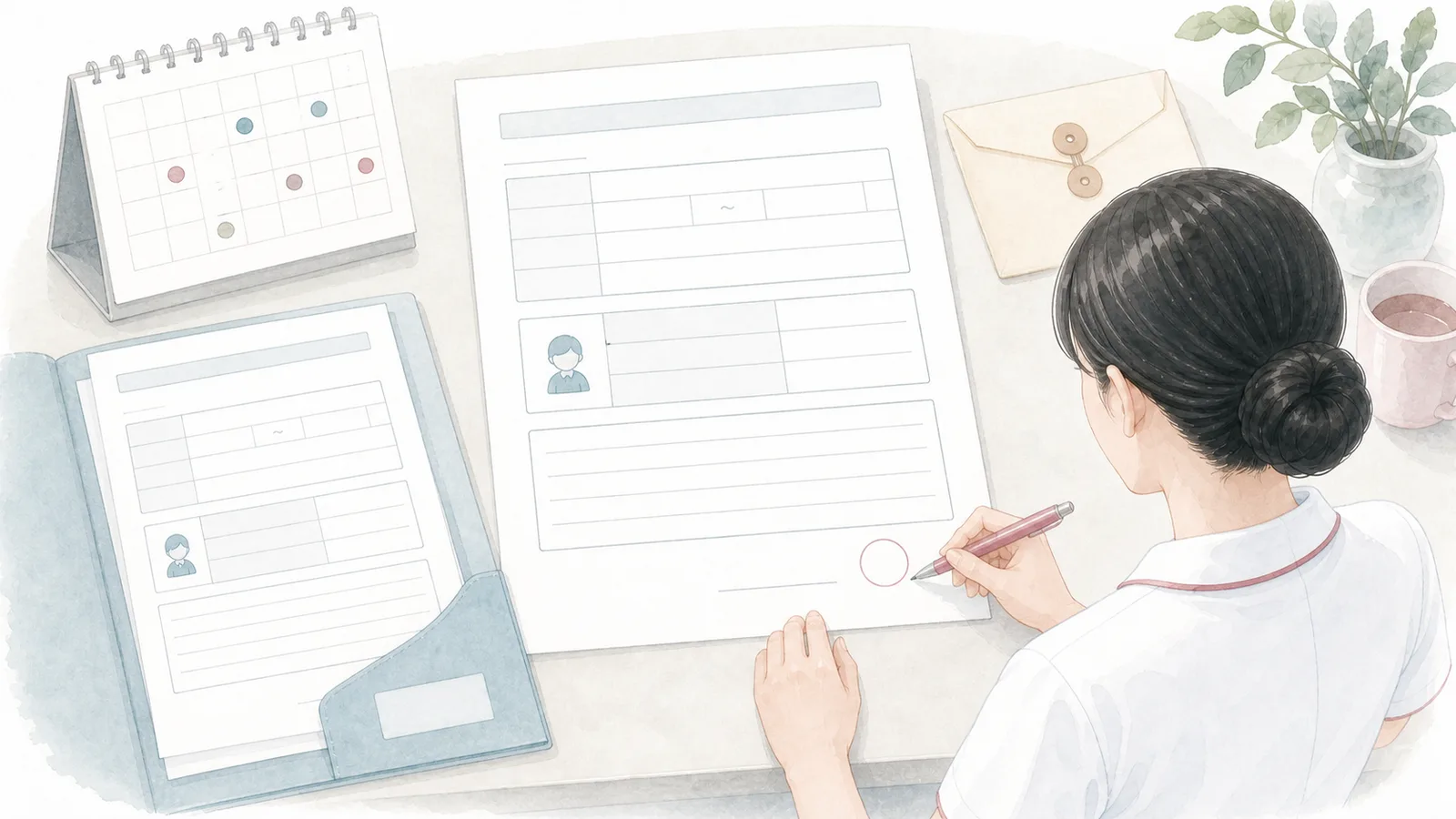
Once the previous chapter has shown that the refusal has no legal basis, the next thing to do is resubmit the request.
Rather than pressing it as an emotional appeal, it is important to submit it again as written evidence that leaves a record.
What to write in the request
What to write in a request for a night-shift exemption, that is, a restriction on late-night work, is the period for which you want the exemption, with its start and end dates.
A restriction on late-night work under the Child Care and Family Care Leave Act must be requested for a period of at least one month and no more than six months per request.
For example, write start and end dates as a pair, such as “from 1 April to 30 September next year”.
If the period exceeds six months, you make several requests divided into six-month blocks.
The division of the period is an easy point to overlook.
The document should also state your name, the child’s name and date of birth, and the date of the request.
Some workplaces provide a form and some do not, so if you cannot find one, check with HR or general affairs.
Ask whether there is a “late-night work restriction request form”.
If there is none, a memo listing your name, the period, the request date and so on works as an expression of your request.
When and to whom to submit
Submit one month before the date you want the exemption to start.
If you submit later than this deadline, the employer cannot arrange things in time.
As a result, the start may slip by days or weeks.
Think of it like handing in next month’s shift preferences by the end of this month: the earlier you state your intention, the more easily it goes through.
Conversely, as long as you keep to the one-month deadline, the employer cannot refuse without very good reason.
At most workplaces, you submit to the head nurse or department head.
But the final decision and the record are usually handled by the HR department.
Handing a copy to HR at the same time as submitting to the head nurse is a safe approach.
Do not let it end as a verbal exchange. Always leave a written record (including submission by email).
Why insist on writing?
Because if the previous request was handled only verbally and no record remains, you are at a disadvantage when explaining the situation at the next consultation service.
Keep a copy of the document you submitted.
That copy also becomes the basis for explaining the situation at a consultation service if refusals continue.
Where to consult if refusals continue
If refusals continue, where to consult splits into the following two according to the law that applies.

Even after resubmitting the request, you may still be refused.
What to do next is not to rush straight to the Labour Bureau or the Labour Standards Inspection Office.
First follow the sequence of consulting within the organisation.
Just as with a complaint you go to the shop counter before phoning head office, in-house consultation has stages too.
The order of consulting in-house
Even if your immediate superior says “no exemption”, you do not have to take that as the final decision of the whole organisation.
It is not unusual for it to be the superior’s personal judgement or a matter of staffing convenience.
The first thing to check is whether the superior’s answer is a conclusion shared with HR, or something that stopped at the superior.
Just establishing where that answer sits changes what you do next.
Many medical institutions and care facilities have, in addition to HR, an in-house consultation service or a harassment consultation service.
A night-shift exemption request not going through is not only a rostering matter.
It can be brought to these services as a matter of combining childcare and work.
If discussion with your superior does not resolve it, let the in-house consultation service or harassment service know the situation as well.
What matters here is to keep a record of the exchanges.
The date of the request, a copy of the document submitted, what your superior or the HR officer said.
Noting these in chronological order lets you convey the situation accurately when consulting an outside body.
Purely verbal exchanges easily turn into “said, didn’t say” arguments as time passes, so take care.
Consulting the Labour Bureau or the Labour Standards Inspection Office
If refusals continue even after exhausting in-house consultation, the place to consult splits into two: the Prefectural Labour Bureau and the Labour Standards Inspection Office.
Many people wonder which to go to. The answer depends on which law the refused request was based on.
The Employment Environment and Equal Employment Department of the Prefectural Labour Bureau is the consultation service when a night-shift exemption request under Article 19 of the Child Care and Family Care Leave Act has been refused.
There you can receive advice and guidance to the company, or mediation (a procedure close to out-of-court conciliation) in which the bureau stands between the worker and the company to seek a resolution.
On the other hand, if late-night work exemption was refused during pregnancy or within one year of the birth, the service changes.
The basis is Article 66, paragraph 3 of the Labor Standards Act.
The place to consult is the Labour Standards Inspection Office.
The inspection office is the body that receives reports of violations of the Labor Standards Act, and in serious cases this can lead to a corrective recommendation to the company.
When you consult, bring the copy of the request form described above and the record of in-house exchanges, and things go smoothly.
Consultation is free.
Some services accept anonymous consultations.
There is no need to worry that “consulting will make it hard to stay at the company”.
Disadvantageous treatment on the grounds of having consulted is also prohibited by law.
From here on, we look at ways of working other than an exemption that can be considered alongside the request.
Ways of working other than an exemption
The right to a night-shift exemption is protected by Article 19 of the Child Care and Family Care Leave Act and Article 66 of the Labor Standards Act.
Even so, some people, having confirmed their legal right, still have doubts about continuing at their current workplace.
Here we set out two options, a transfer and a job change, together with the change in income.
After leaving night shifts, how does income change?
In most cases, monthly pay falls by the amount of the night-shift allowance.
But how it falls depends on the workplace’s pay rules, so here we touch on it only as a general tendency.
Switching to day-based work at the same workplace
The first thing to consider is transferring to a department without night shifts while staying at the same workplace.
If there is a day-based department such as outpatients, day care or medical affairs, you can change only how you work while keeping familiar relationships and duties.
Before requesting a transfer, there are three points to check.
- Whether there is a vacancy in a day-only department
- That the transfer may remove the night-shift allowance and lower your monthly pay
- When and to whom to express your wish to transfer (telling HR as well as the head nurse moves things along)
The benefits of staying at the same workplace are large.
You can keep working in a familiar environment and carry over the assessment and trust built up before parental leave.
There are disadvantages too.
If there is no vacancy in the department you want, you may have to wait, and in some departments the work changes greatly and you may have to learn from scratch.
Moving to a workplace with few night shifts
When an in-house transfer is difficult, the remaining option is changing jobs.
Workplaces with almost no night shifts include clinic outpatient departments, health-check centres and home-visit nursing stations.
Home-visit nursing is mainly daytime rounds, but some workplaces include on-call duty for emergencies.
On-call is like handing your private hours to the workplace in a different form from night shifts.
Be sure to check whether the job advert states the existence and frequency of on-call duty.
The benefit of changing jobs is getting away from the night-shift-based working pattern altogether.
That it is easier to keep a regular rhythm of life is, after all, the heart of the reason for seeking an exemption.
The disadvantages are that length of service resets and that building relationships at a new workplace takes time.
Pay is also likely in many cases to be lower than before parental leave, because there is no night-shift allowance.
Whichever you choose, you will want to translate the change in income into your household budget before comparing.
In the next section we line up four options, including these two, and check the axes that help when you cannot decide.
Material for deciding when you cannot make up your mind
When you cannot decide, try fitting your situation to the following three axes.
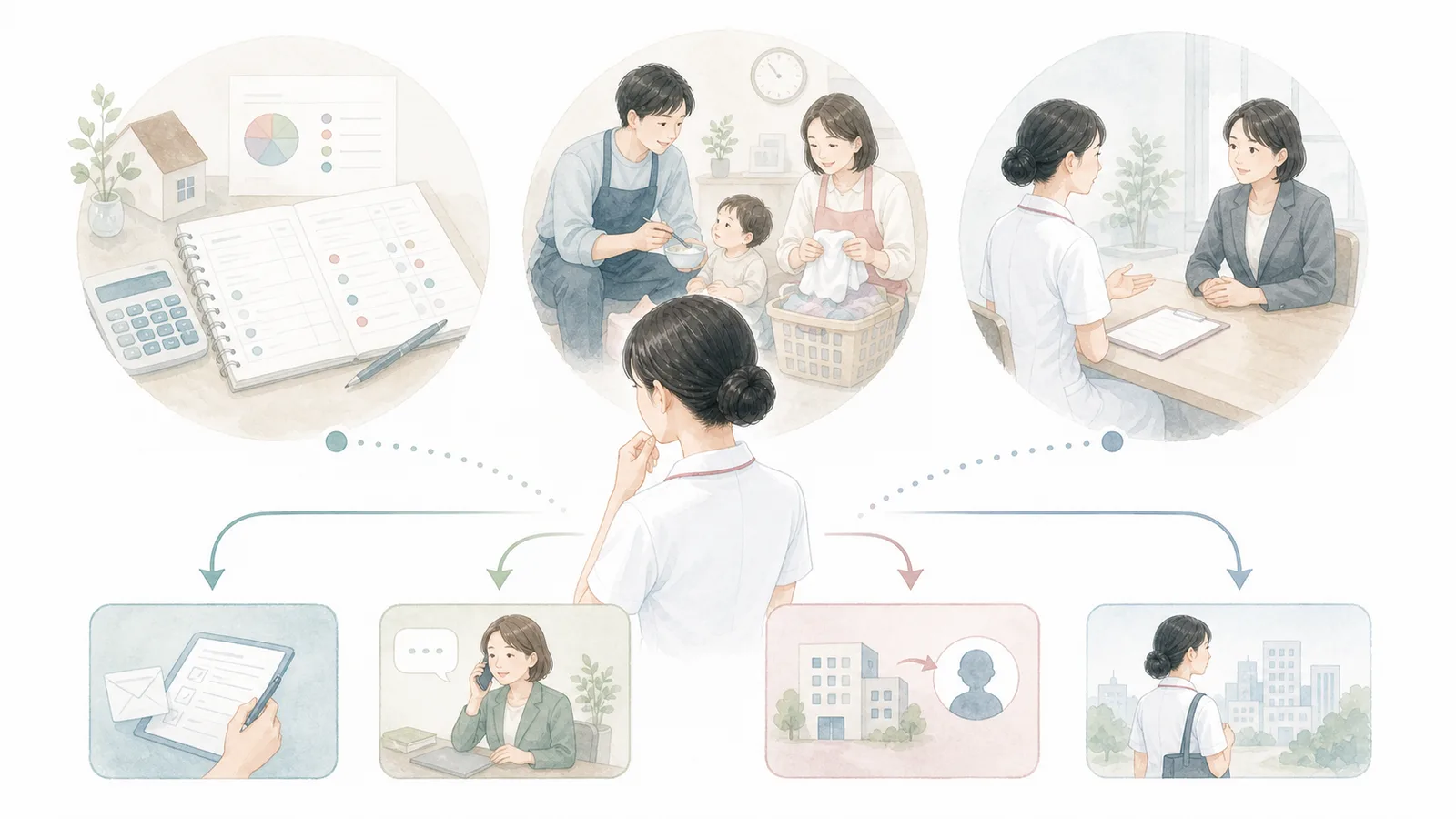
Even after checking the legal basis, how to resubmit, and where to consult, some people still cannot settle on which to choose.
The axes that resolve that hesitation come down to three.
How far the household can withstand a change in income, how much your partner can share childcare and housework, and whether the workplace shows a willingness to talk.
Fitting your situation to these three axes shows which of the four options, resubmitting, consulting a service, changing how you work, or changing jobs, is the move to make now.
First, think about the household floor.
Without the night-shift allowance, monthly take-home pay changes considerably.
The exact reduction differs by employer and working pattern, so check the actual amount of your night-shift allowance on your payslip first.
If night shifts disappear through a transfer or a job change, the allowance is lost outright.
By contrast, resubmitting the request or using a consultation service does not change the employment contract itself, so the effect on the household is small.
Next, consider your partner’s cooperation.
How far can your partner or family take on childcare and drop-off and pick-up during night shifts?
The harder it is to share childcare and housework, the greater the need to have the workplace grant the exemption itself.
Conversely, in a household where cooperation is easy to get, a way of working that keeps some night shifts may be manageable.
Finally, think about the workplace’s attitude.
If your superior and HR engage in discussion and consider alternatives with you, there is a good chance that resubmitting or the in-house consultation service alone will resolve it.
On the other hand, some workplaces will not engage even when shown the legal basis, or simply repeat the same explanation.
At a workplace that will not talk, switching early to consulting the Labour Bureau or the Labour Standards Inspection Office, or to considering a transfer or a job change, rather than piling up in-house exchanges, prevents wasted time and energy.
The table below sets out the relationship between the three axes, household budget, partner’s cooperation and workplace attitude, and the four options.
The actual effect varies with your employer’s pay structure and family circumstances, so use it only as a starting point for comparison.
| Option | Effect on household budget | Easy to choose even with little partner support? | Workplace attitude it suits |
|---|---|---|---|
| Resubmitting the request | Small (night-shift allowance likely kept) | Easy | Willing to talk |
| Consulting a service | Small (employment contract unchanged) | Easy | Repeats the same explanation with no progress |
| Changing how you work (transfer) | Moderate (allowance may fall) | Easy | Has day-based departments in-house |
| Changing jobs | Large (pay structure changes) | Harder (big change of environment) | No room at all for discussion |
As the table shows, there is no single right answer, but combinations.
You can also pursue several options at once.
For example, resubmitting the request while also consulting the Labour Bureau.
What matters is to check how your current situation fits the three axes: the household floor, your partner’s cooperation, and the workplace’s attitude.
Finally, let us pick up the smaller questions not covered so far as frequently asked questions.
Frequently Asked Questions
Some of this overlaps with the above, but here are three questions people often have individually, answered one by one on the basis of the statutes.
Can I get an exemption for a primary-school child?
In short, the night-shift exemption guaranteed by law covers, in principle, pre-school children.
The late-night work exemption under Article 19 of the Child Care and Family Care Leave Act covers workers raising a child who has not yet reached primary-school age, and the legal right of request ends once the child starts school.
That said, it is premature to assume there is no exemption at all after school starts.
Some companies, as their own scheme above the legal standard, extend the exemption to children in the middle or upper years of primary school.
Check once whether your work rules or in-house childcare regulations set an age above the legal one.
Do I need a medical certificate?
No medical certificate is needed.
A night-shift exemption under Article 19 of the Child Care and Family Care Leave Act can be requested if you meet the requirements on the child’s age and length of service, and a doctor’s opinion is not a requirement.
It is a different matter, however, if you also apply for a transfer to lighter duties under Article 66 of the Labor Standards Act on grounds of morning sickness or poor health.
The company may ask for a medical certificate as material for adjusting your duties.
If asked, prepare one after consulting your obstetrician.
Can I refuse to switch to part-time?
Yes.
You have the right to request a night-shift exemption while remaining a full-time employee, and agreeing to a change of employment type is not a condition of receiving the exemption.
Is it really true that you can only drop night shifts by going part-time?
In practice, most cases where that is said rest not on the law but on the workplace’s operational convenience.
When a change of employment type is suggested, it is worth pausing to check whether it is really a necessary condition.
Summary
Are you on the verge of giving up your current way of working because of one line from your superior, “we can’t exempt you from night shifts”?
As we have seen, in many cases a refusal of a night-shift exemption has little legal basis.
But the applicable system changes with the timing of the request.
Within one year of the birth it is Article 66, paragraph 3 of the Labor Standards Act; after that it is Article 19 of the Child Care and Family Care Leave Act, so the governing provision switches.
Letting it end with “they said it can’t be done” without knowing this difference is a waste.
There is one thing you can do starting today.
First, check which system you are covered by.
Then decide whether to resubmit the request, consult an in-house service, or rethink how you work.
Choose according to your situation.
The word “no” may feel heavy, but the law is on your side more often than you think.
If nothing moves in-house, outside services such as the Labour Bureau and the Labour Standards Inspection Office are there too.
Thank you for reading to the end.
The goal of this article is that you, who stopped in your tracks the moment you were told “no”, can now explain in your own words what to do next.
Primary sources consulted
- e-Gov Laws and Regulations, “Labor Standards Act”
- e-Gov Laws and Regulations, “Child Care and Family Care Leave Act”
- MHLW, Q&A on reviewing working hours for energy saving, 5: consideration for workers with family responsibilities
The statistics and legal references in this article were checked directly against these original sources by the editorial team. Figures are reviewed as new survey years are published.
Descriptions of laws and rules are general explanations. For your individual situation, check with your employer’s rules or a specialist service such as the Prefectural Labour Bureau.
Related: Returning to nursing after a career gap | What the fear really is, and how to come back in stages