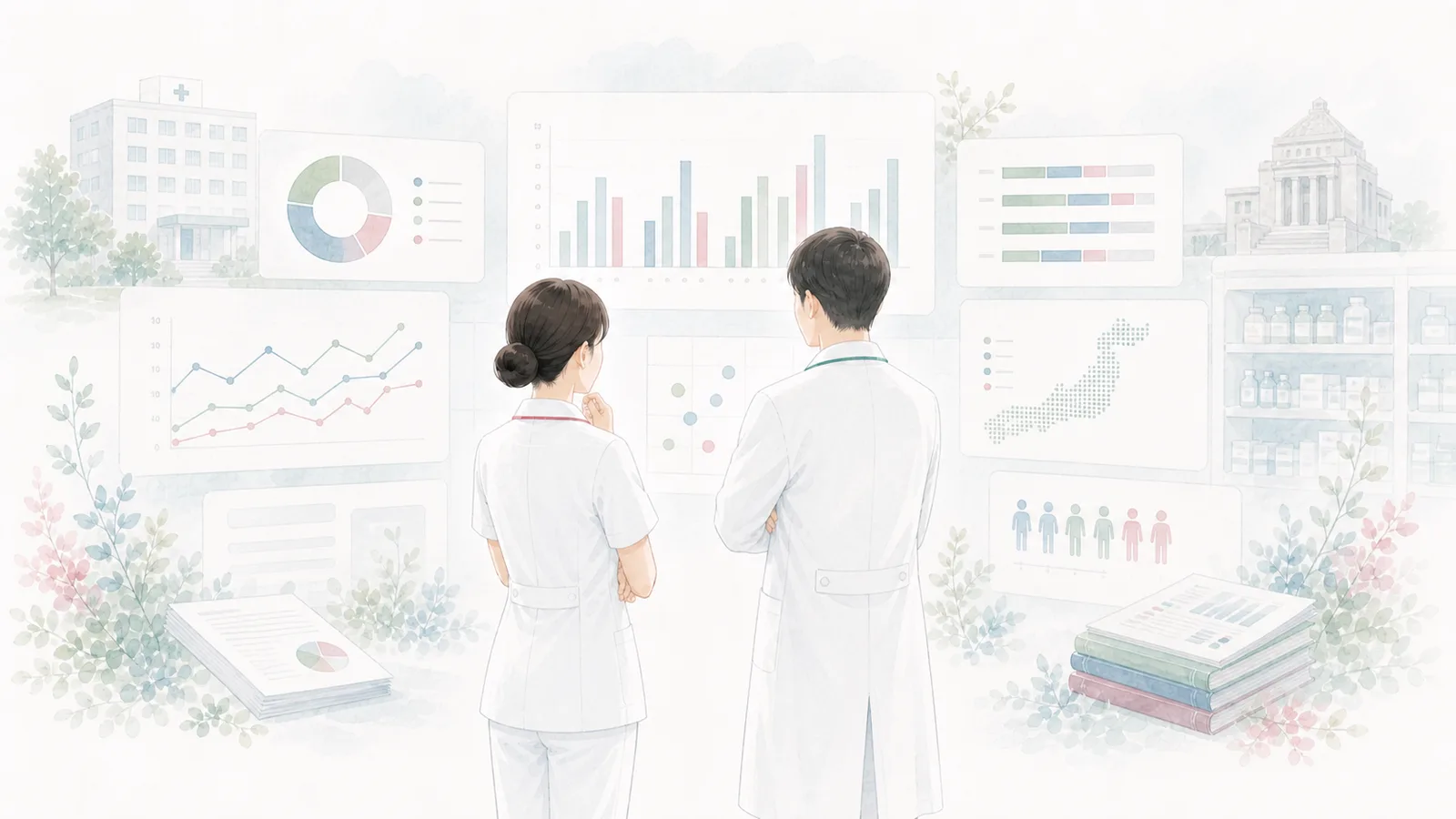
This page is a reference collection of the figures that sit behind career decisions for nurses and pharmacists in Japan, compiled only from primary statistics published by the government and public professional bodies. We do not use proprietary tallies or estimates from recruitment sites. Every figure carries the survey name, the reference date and a link to the source. We update the statistics each time new figures are released, and the date of our last check appears at the end of the page. The underlying data for the numbers used in our individual articles is also gathered here.
How many nurses are there?
From the Ministry of Health, Labour and Welfare (MHLW), “Report on Public Health Administration and Services, 2024 (Employed Health Care Workers)” (as of 31 December 2024, published 29 July 2025).
| Profession | Employed | Change from previous survey (end of 2022) |
|---|---|---|
| Registered nurses (看護師) | 1,363,142 | +51,455 (+3.9%) · highest since the survey began |
| Assistant nurses (准看護師) | 233,022 | −21,307 (−8.4%) |
| Public health nurses (保健師) | 63,536 | +3,237 (+5.4%) · highest since the survey began |
| Midwives (助産師) | 38,721 | +658 (+1.7%) |
The simple total of the four professions is 1,698,421 (our own calculation; MHLW does not publish this as an official total).
What stands out is the difference in direction. Registered nurses keep setting new records, while assistant nurses alone have fallen sharply, by 8.4%. The composition of the nursing workforce is clearly shifting from assistant nurses to registered nurses.
Where registered nurses work: hospitals 65.7% (895,944), clinics 14.3% (194,665), long-term care insurance facilities and similar 7.9% (107,984), home-visit nursing stations 6.7% (91,022), social welfare facilities 2.1% (28,093), nursing schools and research institutions 1.2% (16,790). Roughly one in three already works outside a hospital.
Male nurses number 118,068 (8.7%), up steadily from 6.8% in 2014.
Source: MHLW, “Report on Public Health Administration and Services, 2024 (Employed Health Care Workers)”
Night-shift allowances and turnover among nurses
From the Japanese Nursing Association, “2025 Survey on Hospital Nursing” (published 31 March 2026).
Night-shift allowance (fixed amount per shift, average)
| Shift pattern | 2025 survey | 2010 |
|---|---|---|
| Two-shift night duty | ¥11,470 | ¥10,745 |
| Three-shift, evening | ¥4,300 | ¥4,077 |
| Three-shift, late night | ¥5,211 | ¥5,053 |
As the association itself points out, night-shift allowances have been almost flat for 15 years. The allowance is the number of shifts multiplied by a unit rate, and the rate is not designed to rise with years of service. This is the figure at the centre of why nurses’ pay tends to feel as though it has hit a ceiling.
Turnover (fiscal 2024): regular nursing staff 11.0%, newly graduated hires 8.4%, experienced hires 16.1%. First-year turnover has stayed within roughly 7.5–10.3% since fiscal 2005, meaning about one in twelve new graduates leaves their workplace within the first year.
Source: Japanese Nursing Association, “2025 Survey on Hospital Nursing”

How many pharmacists are there?
From MHLW, “Survey of Physicians, Dentists and Pharmacists, 2024” (as of 31 December 2024, published 23 December 2025).
The total number of registered pharmacists is 329,045 (+5,355, +1.7% from the previous survey). Their places of work break down as follows.
| Place of work | Number (share) | Change |
|---|---|---|
| Pharmacies | 197,437 (60.0%) | +6,702 (+3.5%) |
| Medical institutions (hospitals and clinics) | 63,290 (19.2%) | +827 (+1.3%) |
| of which hospitals | 57,595 | up |
| of which clinics | 5,695 | −183 (−3.1%) |
| Pharmaceutical-related companies | 34,184 (10.4%) | −2,902 (−7.8%) |
| Universities | 5,011 (1.5%) | +109 |
Pharmacies grew 3.5% while pharmaceutical-related companies fell 7.8% (retail sales businesses within that group fell 17.2%), so pharmacists’ workplaces are shifting towards the dispensing front line. The gender split is 38.0% men and 62.0% women, and the overall average age is 46.9.
Average age by type of facility: hospitals 42.5, pharmacies 46.8, clinics 58.4. Hospitals are the youngest group of all, and the age structure reflects a common path of gaining experience in a hospital while young and moving to pharmacies and other settings later on.
Source: MHLW, “Survey of Physicians, Dentists and Pharmacists, 2024”
Pharmacist pay (overall average)
From MHLW, “Basic Survey on Wage Structure, 2025” (wages for June 2025). For pharmacists (men and women, establishments with 10 or more employees), regular monthly cash earnings are ¥398,700 and annual bonuses and other special pay are ¥883,500. A simple annual conversion gives roughly ¥5.7 million (average age 40.1, average tenure 8.6 years). For part-time pharmacists, scheduled hourly pay is ¥2,540.
Note that no government statistic directly compares pay by type of workplace (pharmacy, hospital, drugstore). If you see definite figures for pay gaps between workplace types, they are most likely a private company’s own tally.
Source: MHLW, “Basic Survey on Wage Structure, 2025” (Table 1 by occupation and Table 1 for part-time workers, as published on e-Stat)
Regional differences in pharmacist supply
Also from the “Survey of Physicians, Dentists and Pharmacists, 2024”. The number of pharmacists working in pharmacies and medical institutions per 100,000 population is 210.6 nationally. It ranges from 256.6 in Tokushima Prefecture at the top to 155.3 in Okinawa Prefecture at the bottom, a gap of roughly 1.6 times (Fukui at 170.4 and Aomori at 175.5 are also low).
The national government treats this imbalance as a policy issue. The “Guidelines for Pharmacist Supply Planning” (2023) name regional and workplace-type imbalances, especially the shortage of hospital pharmacists, and each prefecture sets a pharmacist maldistribution index and designates pharmacist-scarce areas. This supply structure is why pharmacist vacancies in regional areas often appear to offer better conditions.
Recruitment fees: who pays recruitment sites, and how much?
When a placement is made, recruitment agencies receive a fee from the hiring side (hospital, pharmacy and so on). MHLW’s published materials show the level of these fees.
- Nursing: national average of ¥639,000 per placement (Employment Placement Business Report, fiscal 2023 results). In the 2019 survey, the average fee for nurses and assistant nurses was ¥918,000, or 19.1% of annual pay (¥4,799,000)
- Pharmacists: average of ¥1,225,000 per hire, or 22.5% of average annual pay of ¥5,436,000 (2019 survey). Average fee rates by agreed-salary band range from 22.6% to 26.6%
In other words, recruitment fees in practice are roughly 20% of the agreed annual salary. This structure is what lies behind the pressure an adviser may feel to push a placement through. It is the premise for our advice, in our articles on recruitment agencies, to use them proactively with an understanding of how they work.
Sources: MHLW, published materials on employment placement businesses / Questionnaire survey on employment placement in the medical and long-term care fields (2019)
Frequently Asked Questions
Can I cite the figures on this page?
The original sources of the figures are the government and public-body statistics listed under each item. When citing, please name the original survey (the relevant MHLW or Japanese Nursing Association survey) as your source. If you refer to our organisation or commentary, we would appreciate a mention of and link to Hakui Career.
How often is this page updated?
Most of the underlying statistics are published on a one- or two-year cycle (the employed health care workers section of the Report on Public Health Administration and Services every two years, the Survey of Physicians, Dentists and Pharmacists every two years, and the Survey on Hospital Nursing and the Basic Survey on Wage Structure annually). We update this page as soon as we have checked a new release and revise the date at the end.
Why do figures such as average annual pay differ from other sites?
Because of differences in method. This page uses only government statistics and public-body surveys and states how each figure is derived (for example, monthly pay × 12 plus bonuses as a simple conversion). Figures on private sites are often tallies of their own registered users or in-house estimates, so the populations differ and the numbers cannot be compared directly. Rather than asking which is right, we recommend checking the source and the method of calculation as you read.
Summary
- Employed registered nurses number 1,363,142, a record high, while assistant nurses fell 8.4%: the workforce is shifting towards registered nurses (end of 2024)
- The two-shift night allowance for nurses is ¥11,470 per shift and has been almost flat for 15 years, the structural background to pay feeling capped
- First-year turnover among new graduate nurses is 8.4%; leaving in the first year is statistically not unusual
- Registered pharmacists number 329,045; pharmacies are up 3.5% and pharmaceutical companies down 7.8%, so workplaces are moving towards dispensing
- Pharmacists per 100,000 population range from 256.6 in Tokushima to 155.3 in Okinawa, a gap of about 1.6 times, and the government has set maldistribution indices
- Recruitment fees in practice are around 20% of the agreed annual salary, the premise for understanding how agencies work before using them
All figures have been verified against the primary sources listed. Last checked: 1 September 2026.
Related: Why nurses’ pay hits a ceiling | Understanding the structure and three routes to raising it