
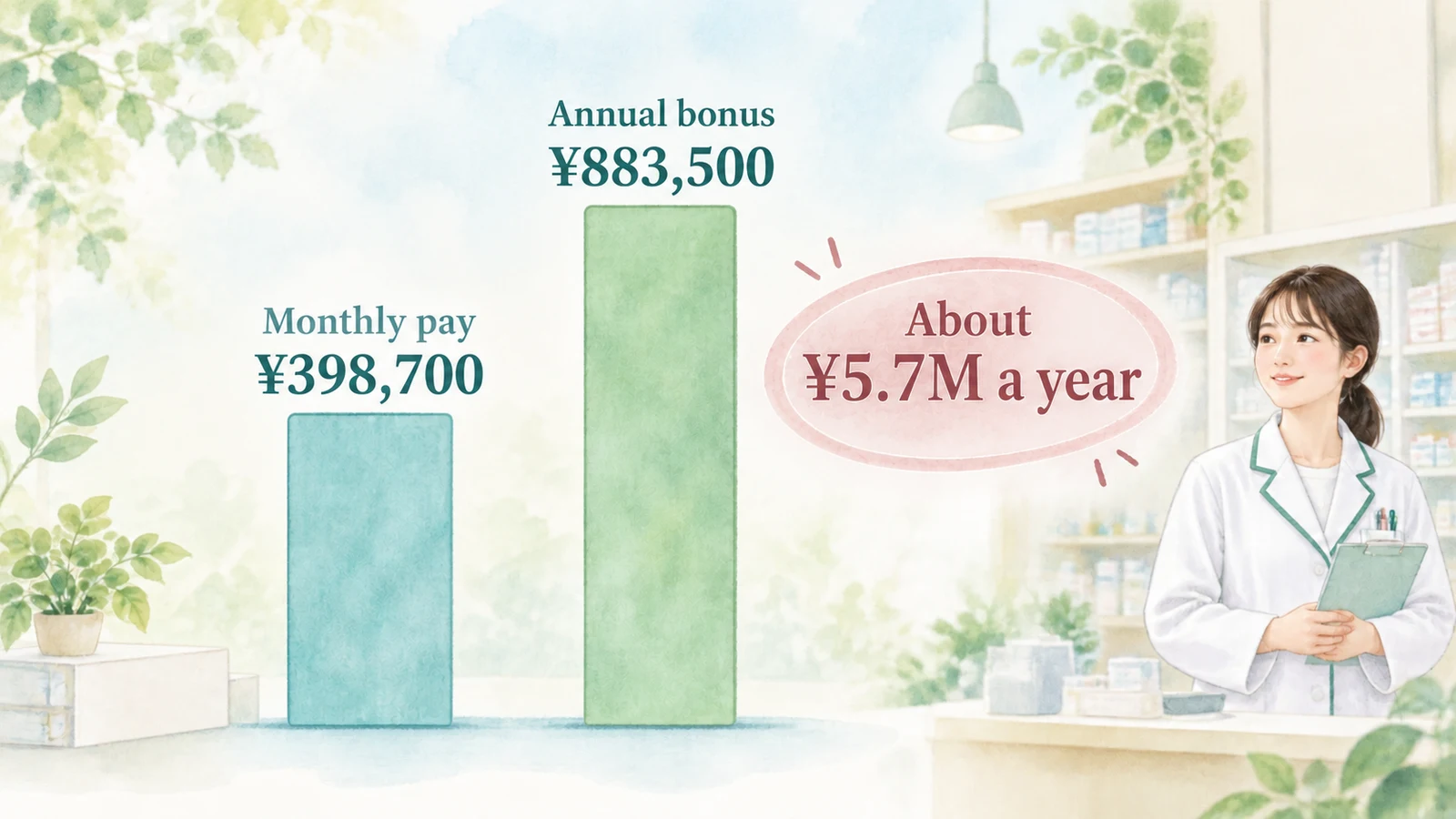
If you have searched for “pharmacist salary in Japan”, you have probably found a spread of numbers with no clear source. This page uses only figures published by the Japanese government, and explains what each figure includes, so you can compare them with your own country on the same footing. The short answer: in 2025, the average pharmacist in Japan received ¥398,700 in monthly pay and ¥883,500 in annual bonuses, which adds up to roughly ¥5.7 million a year before tax. The rest of this page explains what sits behind that number, where pharmacists actually work, why pay varies by region, and what a pharmacist licensed outside Japan would need in order to work here.
The headline figures
The source is the Ministry of Health, Labour and Welfare’s “Basic Survey on Wage Structure, 2025”, which reports wages for June 2025 at establishments with 10 or more employees. For pharmacists, men and women combined, the figures are as follows.
| Item | Figure |
|---|---|
| Regular monthly cash earnings | ¥398,700 |
| Annual bonuses and other special pay | ¥883,500 |
| Simple annual conversion (monthly × 12 + bonuses) | about ¥5.7 million |
| Average age of respondents | 40.1 |
| Average years of service | 8.6 |
| Part-time pharmacists, scheduled hourly wage | ¥2,540 |
Source: MHLW, “Basic Survey on Wage Structure, 2025” (occupational tables published on e-Stat).
These are averages across the whole profession, not starting salaries. The average respondent is 40 years old with more than eight years at the same employer. A newly licensed pharmacist in their mid-twenties will usually earn less than this, and a pharmacist managing a pharmacy will usually earn more.
We have deliberately not converted these figures into US dollars or euros. Exchange rates have moved a great deal in recent years, and a conversion made today can be misleading a few months later. Use the yen figures and convert at the rate that matters to you.
What “monthly pay” means in Japan
Japanese pay statistics use categories that do not map neatly onto other countries’ payslips. Two points matter when you read the table above.
First, “regular monthly cash earnings” is the amount paid every month before tax and social insurance deductions. It includes base salary and fixed allowances, and it also includes overtime pay. It does not include bonuses.
Second, bonuses in Japan are typically paid twice a year, in summer and winter, and for many employers they form a substantial part of annual income. That is why the survey reports them separately, and why quoting only the monthly figure understates what a pharmacist actually takes home over a year. The ¥5.7 million figure above is a simple arithmetic combination of the two, not a figure the survey itself reports.
Take-home pay after income tax, resident tax, health insurance, pension and employment insurance is lower. The exact amount depends on family circumstances and municipality, so this page does not attempt a net figure.
No official breakdown by type of workplace
You will find websites claiming that hospital pharmacists earn a specific amount less than pharmacy or drugstore pharmacists. No Japanese government statistic compares pharmacist pay by type of workplace. The wage survey reports the occupation as a whole. Figures that split pay by pharmacy, hospital and drugstore are private tallies by recruitment companies, based on their own placements, and should be read as such.
What the government does publish is where pharmacists work and how old they are, from the “Survey of Physicians, Dentists and Pharmacists, 2024”.
| Workplace | Pharmacists | Average age |
|---|---|---|
| Pharmacies | 197,437 (60.0%) | 46.8 |
| Hospitals | 57,595 | 42.5 |
| Clinics | 5,695 | 58.4 |
| Pharmaceutical companies, wholesalers and drugstore head offices | 34,184 (10.4%) | 49.1 |
| All registered pharmacists | 329,045 | 46.9 |
Source: MHLW, “Survey of Physicians, Dentists and Pharmacists, 2024”.
Six in ten pharmacists work in community pharmacies. Hospital pharmacists are the youngest group, which reflects a common career pattern: gain experience in a hospital early on, then move to a pharmacy later. Pharmacists in companies fell by 7.8% over two years, so that route is narrowing rather than widening.
Pay is higher where pharmacists are scarce
Japan has a national average of 210.6 pharmacists per 100,000 people working in pharmacies and medical institutions, but the figure ranges from 256.6 in Tokushima Prefecture to 155.3 in Okinawa Prefecture, a gap of roughly 1.6 times. The national government treats this as a policy problem and each prefecture designates areas where pharmacists are in short supply.
The practical consequence is that job offers in regional areas with few pharmacists tend to carry better conditions, sometimes with housing or relocation support, because employers there cannot rely on a steady flow of applicants. A pharmacist willing to move away from Tokyo, Osaka or other large cities can often negotiate a better package than the national average suggests. The trade-offs, including single-pharmacist stores and car-dependent living, are covered in our Japanese-language article on working as a pharmacist in regional Japan.
Can a pharmacist licensed abroad work in Japan?
This is the question most readers from outside Japan actually have, so here is the legal position in plain terms.
Under the Pharmacists Act, anyone who wants to practise as a pharmacist in Japan must hold a licence from the Minister of Health, Labour and Welfare (Article 2), and that licence is granted only to people who have passed the Japanese national pharmacist examination (Article 3). There is no route that recognises a foreign licence directly.
Article 15 sets out who may sit the examination. Besides graduates of Japanese universities, it admits people who graduated from a school of pharmacy abroad, or who hold a foreign pharmacist licence, and whom the Minister has recognised as having academic ability and skills equal to or above those of a Japanese graduate. In practice, that recognition is an individual assessment of your education, and the examination itself is conducted in Japanese.
Two further points follow from this. First, the assessment and the examination take time and require a high level of Japanese, so this is a multi-year path rather than a transfer. Second, roles that do not require a Japanese pharmacist licence, for example in pharmaceutical companies, are governed by ordinary employment and immigration rules, not by the Pharmacists Act. If you are considering either route, the Ministry’s own guidance is the place to confirm current procedures. This page describes the law in general terms and is not individual advice.
How to read the numbers for your own decision
If you are comparing Japan with another country, three cautions will save you from a wrong conclusion.
The average hides a wide range. Age, years of service, region and role all move the figure, and the survey’s average respondent is already mid-career.
Bonuses are part of the deal. Comparing a Japanese monthly figure with an annual salary elsewhere, without adding the bonus, undercounts Japanese pay by roughly a fifth.
Workplace-type comparisons are not official. Treat any precise “hospital versus pharmacy” gap as a private estimate, however confidently it is stated.
For the wider picture of the profession, including nurse pay and turnover, see Nurse and Pharmacist Salaries in Japan (2025). For how the supply of pharmacists is expected to develop through 2045, our Japanese-language article on the government’s supply and demand projection sets out the official figures.
Frequently Asked Questions
How much does a pharmacist make per month in Japan?
According to the 2025 Basic Survey on Wage Structure, the average regular monthly cash earnings for pharmacists were ¥398,700 before tax. This includes base pay, fixed allowances and overtime, but not bonuses, which averaged a further ¥883,500 a year.
Do hospital pharmacists earn less than pharmacy pharmacists in Japan?
No government statistic answers this directly, because the wage survey does not split pharmacists by workplace type. What is known is that hospital pharmacists are younger on average (42.5) than pharmacy pharmacists (46.8), which by itself would tend to lower the hospital average. Specific gap figures you see online come from private data.
Can I work as a pharmacist in Japan with a foreign licence?
Not directly. You would need to be recognised by the Minister of Health, Labour and Welfare as having qualifications equivalent to a Japanese graduate, then pass the national pharmacist examination, which is held in Japanese. Confirm current procedures with the Ministry before planning around this.
Summary
- In 2025, Japanese pharmacists averaged ¥398,700 in monthly pay and ¥883,500 in annual bonuses, roughly ¥5.7 million a year before tax (average age 40.1, 8.6 years of service)
- Part-time pharmacists earned a scheduled hourly wage of ¥2,540
- No official statistic breaks pay down by pharmacy, hospital or drugstore; such figures are private estimates
- Pharmacist density varies 1.6 times between prefectures, and offers in under-supplied regions tend to be better
- A foreign licence is not recognised directly; the path runs through ministerial recognition and the Japanese national examination
Primary sources
- MHLW, “Basic Survey on Wage Structure, 2025”
- MHLW, “Survey of Physicians, Dentists and Pharmacists, 2024”
- e-Gov Law Search, Pharmacists Act, Articles 2, 3 and 15
All figures and legal provisions on this page were checked against the original sources by the editorial team. Figures are revised when new survey years are published.
Descriptions of laws and statistics are general information, not individual advice. For licensing procedures, confirm with the Ministry of Health, Labour and Welfare.
Related: Working as a pharmacist in regional Japan (Japanese)